

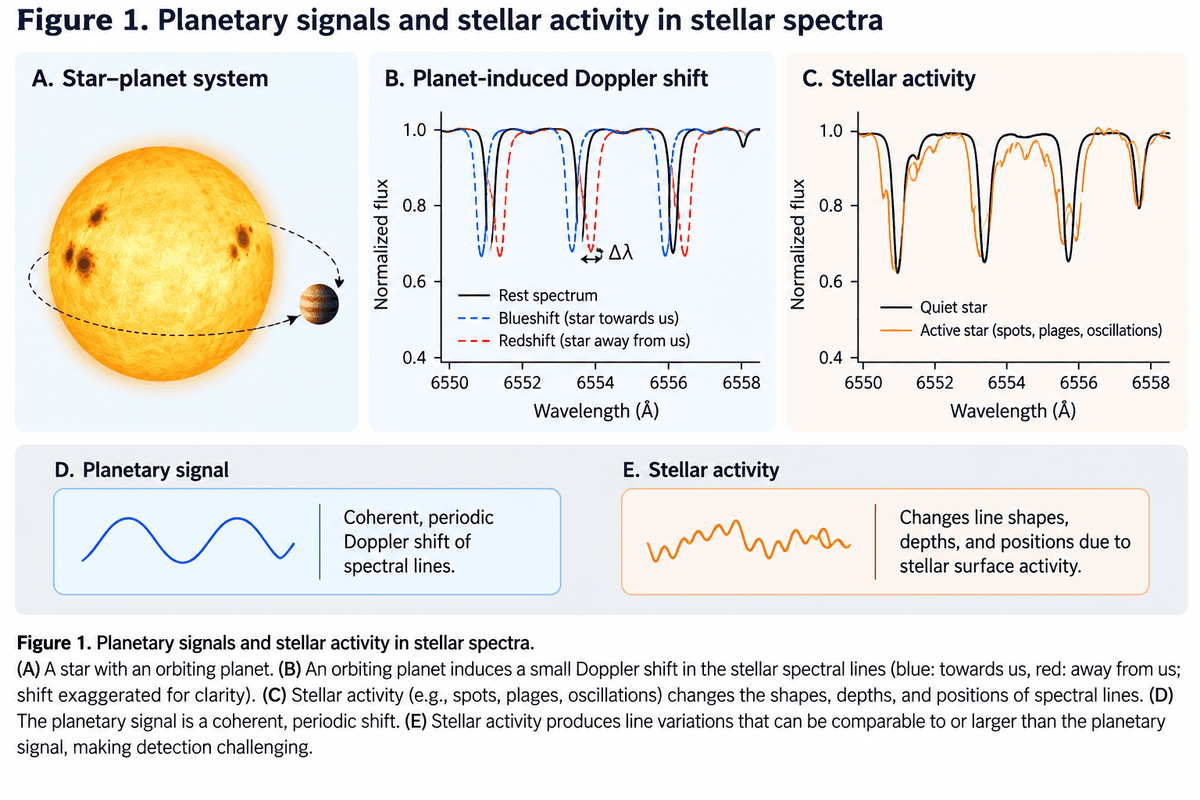
Our research focuses on improving the detection of exoplanets using the radial velocity (RV) method. RV observations detect planets by measuring the tiny Doppler shifts in a star’s spectrum caused by the gravitational pull of an orbiting planet. With improvements in observational precision stellar activity becomes an increasingly important limitation. Oscillations, surface motions, and other activities of the star can produce spectral variations that obscure or mimic planetary signals.
In our recent work, we developed a machine-learning framework to identify planetary signals in high-precision RV observations in the presence of realistic stellar activity and noise. Traditionally, astronomers first convert a series of spectra into measurements of how a star’s velocity changes over time. They then search these measurements for repeating patterns that could indicate an orbiting planet. Instead, we used information directly from the changing stellar spectra, retaining information from spectral lines. This representation captures both the tiny Doppler shifts caused by an orbiting planet and changes in the spectral lines produced by stellar activity.

We trained a Vision Transformer on solar observations from the NEID spectrograph, using synthetic planetary signals injected into real observations of the Sun. A Vision Transformer is a machine-learning model that uses an attention mechanism to identify relationships between different parts of its input images. In this work, it allows the model to learn patterns across the time-dependent representation of the stellar spectra.
A central challenge was designing the model to work with realistic astronomical data, which are often irregularly sampled and contain long observational gaps. We developed a two-stage training strategy. First, the model learned to recognise the signatures of planetary motion. It was then fine-tuned using observations in their actual chronological order. This allowed the model to account for the time-dependent behaviour of stellar activity when identifying planetary signals.
The resulting model predicts the likely orbital period and semi-amplitude of the planetary signal. We tested it using extremely weak planetary signals, including cases where variations produced by stellar activity were stronger than the signal of the planet. We compared its performance with the Lomb–Scargle periodogram, a standard technique used by astronomers to search for repeating signals in observational data. In the weakest-signal regime, the model improved period identification by approximately a factor of two.
The results demonstrate that information contained in stellar spectra can be useful for identifying planetary signals that may be difficult to recover after the spectra have been reduced to a single RV measurement. Rather than replacing established astronomical techniques, this approach provides an additional way to extract information from the complex spectral signatures produced by both planets and stellar activity.
More broadly, this project explores how modern machine-learning methods can complement established astronomical techniques in the search for increasingly small planetary signals. Our interest is in developing such methods as tools that can extract physically meaningful information from complex observational data.