Asteroseismology
Stars
Measuring stellar structure, rotation, and evolution from photometric variability in Kepler and TESS data.
The Kepler and TESS space telescopes have produced photometric time series for hundreds of thousands of stars with a precision no ground-based facility can match. Buried in those light curves are the frequencies of stellar oscillations — asteroseismic 'heartbeats' that encode stellar age, mass, helium content, and internal rotation.
We apply encoder–decoder neural networks and Bayesian inference to extract those signals at scale. A particular focus is red giants, where the coupling of gravity and pressure modes produces mixed modes that probe the stellar core directly. Our 2025 detection of anomalously fast core rotation in a sample of red giants challenged standard stellar evolution models.
Related publications
See all in Stars →Potential of Gaia XP Spectra in Red Giant Star Asteroseismology: A Deep-Learning Approach
Rajarshi Barman, Shatanik Bhattacharya, Shravan Hanasoge, Siddharth Dhanpal
arXiv preprint (2026)
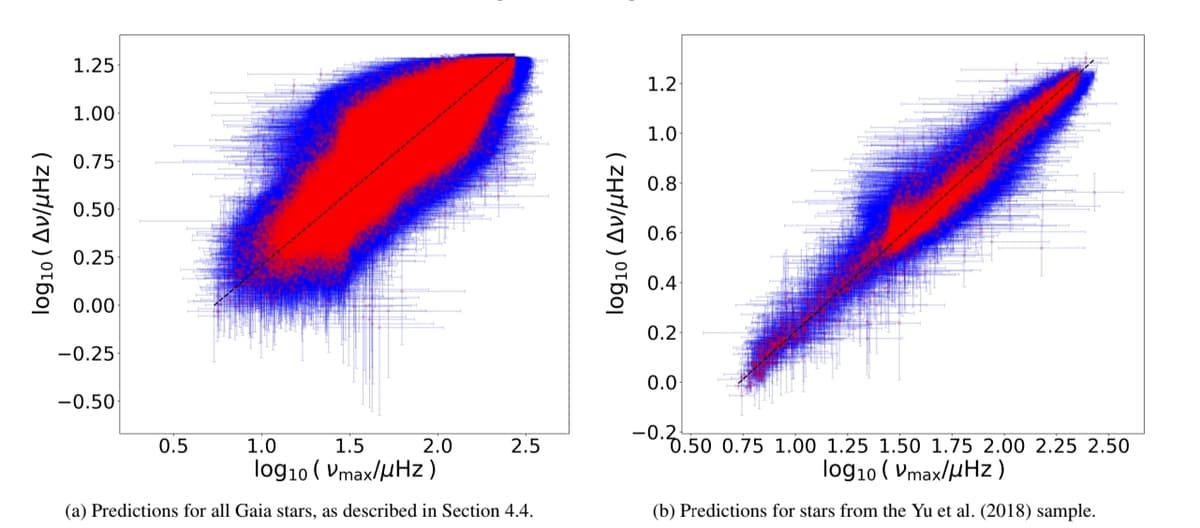
Red giants are tracers of stellar evolution & Galactic structure & their asteroseismic properties, particularly large frequency separation, frequency of maximum oscillation power & dipole-mode period spacing, provide direct insight into their internal structure, masses & evolutionary states. Until now, seismic inferences on large stellar samples relied primarily on high-quality light curves from missions such as Kepler & TESS, or on moderate-resolution spectroscopy (LAMOST: R \~ 1800 & APOGEE: R \~ 22500) that clearly preserve information correlated with these seismic quantities. With Gaia XP spectra (R \~ 15-85), the possibility arises to extend asteroseismic measurements to orders of magnitude more stars, despite the much lower spectral res. . Our goal is to assess whether XP spectra retain enough information to enable reliable seismic inference for RGs. We develop hybrid CNN-LSTM models trained on RGs with seismic parameters measured from Kepler photometry. The networks learn the subtle spectral signatures, imprinted through global stellar properties, that correlate with \\Delta\\nu, \\nu_max & \\Delta\\Pi_1. The models recover all three global asteroseismic parameters from Gaia XP spectra with accuracies comparable to results based on moderate-res. surveys such as LAMOST, demonstrating that even low-res. spectrophotometry carries sufficient information for seismic prediction. Saliency analysis reveals wavelength regions most strongly associated with seismic sensitivity & highlights physically distinct spectral behaviour between RGB & RC stars. Applying our models to Gaia DR3 yields seismic predictions for more than 2.5 M bright RGs, enabling population-level asteroseismic studies on an unprecedented scale. We also identify a small subset of low-\\Delta\\nu red clump candidates showing unusual spectral-seismic correlations, offering new avenues for investigating evolved stellar populations.
Team members
- Shravan HanasogePrincipal Investigator
- Meenakshi GairaPostdoctoral Researcher
- Anohita MallickPostdoctoral Researcher
- Anoop GavankarPhD Student
- Nipun GhanghasPhD Student
- Shatanik BhattacharyaPhD Student
- Rajarshi BarmanJunior Research Fellow
- Jharnesh VermaJunior Research Fellow
- Tarun JangiyaniJunior Research Fellow
- HarikrishnanJunior Research Fellow
Collaborators
- Google DeepMindComputing
- Max Planck Institute for Solar System ResearchInternational
- California Institute of TechnologyInternational
- Google DeepMindInternational
For all peer-reviewed publications across the group, see the full publications page.
All publications →