Helioseismology
The Sun
Imaging flows, magnetic fields, and convection in the solar interior using acoustic oscillations.
The Sun rings like a bell. Millions of propagate through its interior, each one carrying a fingerprint of the medium it traversed. For thirty years, helioseismology has exploited this fact to measure the Sun's internal rotation, sound-speed profile, and helium abundance — but the field hit a wall. Convective velocities predicted by models are an order of magnitude larger than what observations reveal.
Our work focuses on resolving this 'convection conundrum' using deep inversion methods and convolutional neural networks trained on simulated solar oscillations. Recent results — published in Nature Astronomy — identified global-scale Rossby waves and magnetically modified oscillation modes that earlier analyses had overlooked.
Related publications
See all in Sun →Evidence for global-scale magnetically modified Rossby waves in the Sun
Shravan Hanasoge, C Hanson
Nature Astronomy, 1-8 (2026)
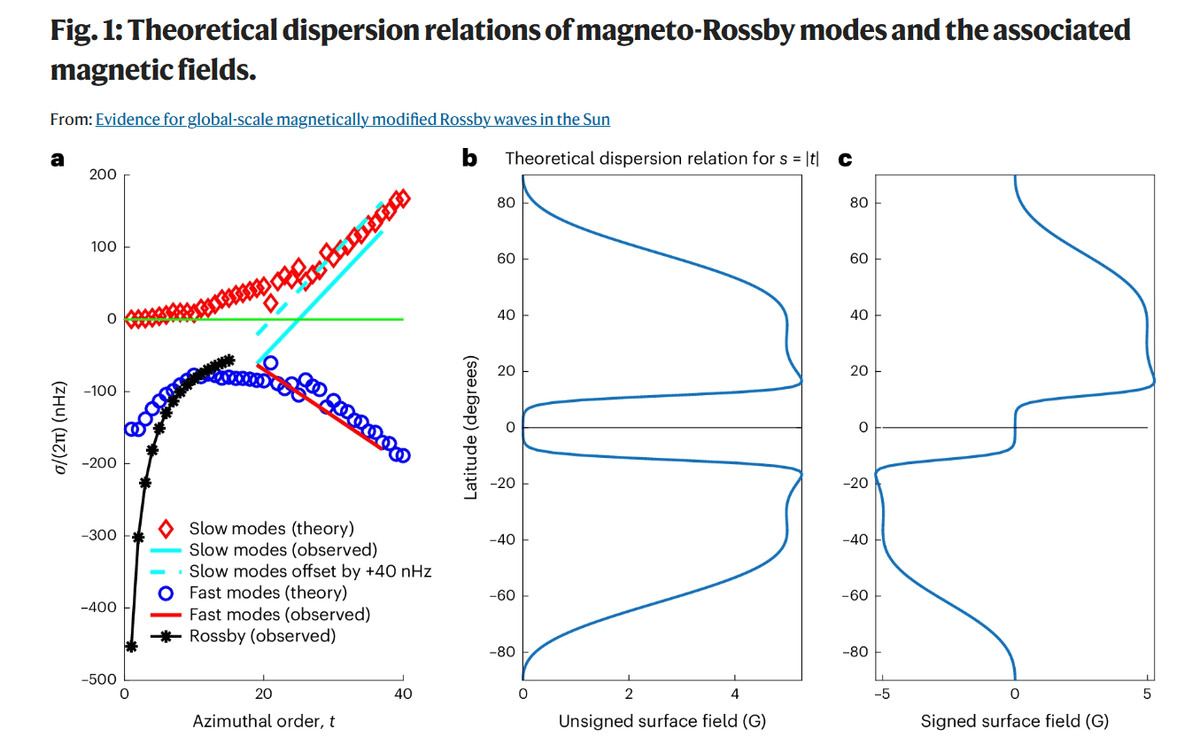
Understanding and predicting solar magnetism is critical for safeguarding satellites, planning space missions and mitigating the effects of space weather on modern infrastructure. However, the physical processes governing the solar cycle remain elusive. Here, applying methods of helioseismology on observations taken by the Helioseismic and Magnetic Imager, we report the possible detection of global magnetized inertial dispersions, a slow mode and a weaker, retrograde feature possibly consistent with the fast mode, whose dynamics are theorized to modulate the solar dynamo. These modes appear to be confined to layers r/R⊙≲ 0.98, exhibit amplitudes weaker than those of hydrodynamic Rossby waves and resonate at frequencies consistent with the presence of an effective large-scale toroidal magnetic field of strength ∼5ρ/ρS Gauss, where ρ is density and ρS ≈ 4 × 10⁻⁷g cm−3 is the surface density. If the toroidal field were to be located at the base of the convection zone (ρ ≈ 0.44 g cm−3), its amplitude would be \~5 × 10³ G, consistent with helioseismic and other estimates. By mapping these motions in the surface layers, we uncover a window into the magnetic architecture of the Sun, offering a potential path towards more accurate forecasts of solar activity.
Indian solar and heliospheric physics vision: Fundamental science to a space weather resilient society
Dibyendu Nandy, Vaibhav Pant, Megha Anand, Jithu Athalathil, Arun Kumar Awasthi, Kshitij Bane, Dipankar Banerjee, B. Ravindra, Ankush Bhaskar, R. Bhattacharyya, Prantika Bhowmik, Ramesh Chandra, Piyali Chatterjee, Subhamoy Chatterjee, A. Dimri, Sneha Gokani, Shravan Hanasoge, Soumitra Hazra, Rajmal Jain, Bhuvan Joshi, K. Nagaraju, Devojyoti Kansabanik, Bidya Binay Karak, C. Kathiravan, Raveena Khan, Hariharan Krishnan, Brajesh Kumar, Sanjay Kumar, Anshu Kumari, Satabdwa Majumdar, Prateek Mayank, Sudheer Mishra, Wageesh Mishra, Atul Mohan, Surajit Mondal, V. Mugundhan, Shyama Narendranath, Divya Oberoi, Megha Pandya, Ritesh Patel, Arghyadeep Paul, Avijeet Prasad, K. Sasikumar Raja, Abhishek Rajhans, R. Ramesh, Chitradeep Saha, K. Sankarasanubramanian, R. Selvakumaran, Rahul Sharma, Rohit Sharma, Arpit Kumar Shrivastav, Nishant Singh, Shirsh Lata Soni, Abhishek Srivastava, Nandita Srivastava, Durgesh Tripathi, Wahab Uddin, Bhargav Vaidya, P. Vemareddy, Geeta Vichare, Gangadharan Vigeesh, Nitin Yadav, Vipin Yadav
Journal of Astrophysics and Astronomy, 46, 51 (2025)
Structure and Dynamics of the Sun's Interior Revealed by the Helioseismic and Magnetic Imager
Alexander Kosovichev, Sarbani Basu, Yuto Bekki, Juan Camilo Buitrago-Casas, Theodosios Chatzistergos, Ruizhu Chen, Jørgen Christensen-Dalsgaard, Alina Donea, Bernhard Fleck, Damien Fournier, Rafael García, Alexander Getling, Laurent Gizon, Douglas Gough, Shravan Hanasoge, Chris Hanson, Shea Hess Webber, J. Todd Hoeksema, Rachel Howe, Kiran Jain, Spiridon Kasapis, Samarth Kashyap, Irina Kitiashvili, Rudolf Komm, Sylvain Korzennik, Natalie Krivova, Jeffrey Kuhn, Zhi-Chao Liang, Charles Lindsey, Sushant Mahajan, Krishnendu Mandal, Prasad Mani, Juan Carlos Martinez Oliveros, Savita Mathur, M. Cristina Rabello Soares, S. Paul Rajaguru, Johann Reiter, Edward Rhodes, Jean-Pierre Rozelot, Philip Scherrer, Sami Solanki, John Stefan, Juri Toomre, Sushanta Tripathy, Lisa Upton, Junwei Zhao
Solar Physics, 300, 70 (2025)
Team members
- Shravan HanasogePrincipal Investigator
- Hemapriya RajuPostdoctoral Researcher
- Arnab PradhanIntegrated MSc-PhD
- Jharnesh VermaJunior Research Fellow
Collaborators
- Google DeepMindComputing
- Max Planck Institute for Solar System ResearchInternational
- California Institute of TechnologyInternational
- Google DeepMindInternational
For all peer-reviewed publications across the group, see the full publications page.
All publications →